A homeowner along the St. Croix River in Lakeland, Minnesota, was watching their shoreline slip away one storm at a time. The bank was steep, the current was strong, and there was no road down to the water to bring in equipment or material.
Natural Environments Corp. was brought in to stabilize the property before the erosion reached the house above. The site sat within a protected scenic byway corridor, which meant the project had to satisfy city, state, and Department of Natural Resources review before any rock could move. Working in Lakeland, MN, during a season when the river ran low, the crew relied on Rip Rap Installation methods built for exactly this kind of steep, hard-to-reach riverbank.
Key Takeaways
- THE CHALLENGEA steep, actively eroding riverbank threatened the property, and the site had no road access for heavy equipment or material delivery.
- THE SYSTEMNatural Environments Corp. barged in 600 tons of rock and installed it as a hard-armoring rip rap system engineered to sit above the 100-year flood line.
- THE RESULTThe finished shoreline includes a stabilized rip rap blanket, a lift, and stairs, built to protect the property for 50 to 100 years.
Loose stone armoring was chosen over a planted or vegetative buffer because the erosion on this stretch of riverbank was too severe for a softer solution to hold. Rock does not wash away or dissolve the way a sand or soil bank does, and its weight is what keeps the water from displacing it. The team's Landscape Design Experts worked through six months of permitting to secure a variance, then coordinated delivery by water since the bank offered no other way in.
Project Summary
| Client Profile: | Riverfront homeowner on the St. Croix River |
| Project Location: | Lakeland, Minnesota |
| Primary Objective: | Stop an imminently collapsing riverbank with a properly engineered Rip Rap Installation |
| System Installed: | 600 tons of hard-armoring rock delivered by barge, part of a broader Shoreline Stabilization approach for the property |
| Key Outcome: | A stable, 27-foot rip rap blanket with a lift and stairs for lasting river access |
Diagnosing A Collapsing River Slope
The initial site evaluation confirmed what the homeowner already feared: the bank was actively failing, not just showing minor wear. The slope was steep enough that standard access roads for equipment were not an option, and the site sat inside a protected scenic byway, which meant local, state, and DNR rules governed nearly every aspect of the work.
To move the project forward, Natural Environments Corp. had to provide engineering proof that the shoreline was imminently collapsing, a critical step in securing a variance that deviated from standard city code. The city engineer also required that the rip rap sit above the 100-year flood line, adjusted for future climate projections, since the finished system was designed to hold for 50 to 100 years.
Barging In 600 Tons Of Rock
Because the bank had no usable road, the team brought in a large barge to move material by river rather than by truck. In total, roughly 600 tons of rock were transported and placed along the slope, with some of the stone temporarily doubling as a working road along the shore to support equipment during construction. The work was scheduled while the river was running low, since water levels on the St. Croix can swing 20 to 30 feet over the course of a season and would otherwise submerge the work area.
Coordinating the Rip Rap Installation Cost and schedule around river conditions, permitting deadlines, and barge logistics required close communication between the crew, the city, and the client throughout the project. The same attention to water movement that shaped the rock placement also informed how the site handled runoff, drawing on the kind of Drainage Solutions Natural Environments Corp. applies across its shoreline and hillside projects.
Lasting Protection For The Riverbank
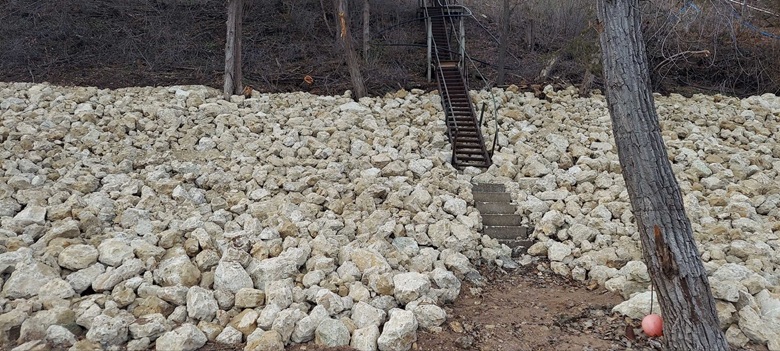
The finished shoreline carries a rip rap blanket that spans 27 feet from the base of the slope to the top, placed above the 100-year flood line as required by the city's review. The loosely placed stone acts as hard armoring, absorbing the force of moving water without shifting or washing downstream the way a soil bank would.
Beyond the stone itself, the property now has a lift system so the homeowner can move up and down the steep bank, along with stairs providing direct access to the beach area below. Built to the standards discussed during permitting, the system is designed to protect the riverbank for 50 to 100 years.
Need Shoreline Protection In Minnesota?
We have handled shoreline stabilization projects along Minnesota's rivers and lakes for more than 40 years, including barge-delivered rip rap on sites with no road access. Every project starts with an honest look at how severe the erosion is and what regulatory approvals will be needed before work can begin.
Is your riverbank or lakeshore showing signs of erosion near Lakeland or the surrounding Twin Cities area? Reach out to talk through what a stabilization plan could look like for your property.
Frequently Asked Questions
How long does rip rap shoreline protection last in Lakeland, MN?
On this Lakeland project, the rip rap system was engineered to last 50 to 100 years. The stone was placed above the 100-year flood line, with allowances for future climate conditions, so it continues to function as water levels fluctuate season to season.
Do you need a permit for rip rap installation along the St. Croix River?
Yes. This project required roughly six months of permitting through city, state, and Department of Natural Resources review because the site sits within a protected scenic byway. Natural Environments Corp. secured a variance by providing engineering proof that the shoreline was imminently collapsing.
Can rip rap be installed on a shoreline with no road access?
It can, though it requires different logistics. On this project, the steep bank had no usable road, so 600 tons of rock were brought in by barge and moved along the river instead of by truck.