A mortared stone retaining wall in South Minneapolis had begun to fail, and the homeowner was worried about what would happen to the driveway and fence sitting just above it. Rather than tear the whole structure out, Natural Environments Corporation set out to salvage what could be saved and stabilize the rest.
The property belonged to a South Minneapolis homeowner whose driveway and fence line ran directly along the top of the wall, meaning any further movement in the stone put both structures at risk. Mortared walls like this one are common throughout older South Minneapolis neighborhoods, and when the mortar joints break down, the failure often starts at the corners. Natural Environments Corporation, a Retaining Wall Installation specialist serving the Minneapolis, MN area, was brought in to address the problem before it spread further.
Key Takeaways
- THE CHALLENGEA failing mortared stone wall threatened to undermine the adjacent driveway and fence.
- THE STABILIZATIONCrews embedded steel connectors and concrete casing at the wall corners and installed a drainage tube at the base.
- THE RESULTThe wall was stabilized and existing materials were salvaged, protecting the driveway and fence without a full rebuild.
A full teardown and rebuild would have meant disturbing the driveway and fence directly, adding cost and disruption the homeowner wanted to avoid. Salvaging the existing stone kept the wall's original character intact while addressing the structural issues at their source. The approach focused on two things: reinforcing the corners, where mortared walls typically fail first, and managing the water pressure building up behind the stone.
Project Summary
| Client Profile: | South Minneapolis Homeowner |
| Project Location: | South Minneapolis, Minnesota |
| Primary Objective: | Stop a common source of Retaining Wall Failure before it reached the driveway and fence. |
| Repair Method: | Steel connectors and concrete casing at the corners, paired with proper Retaining Wall Drainage at the base. |
| Key Outcome: | A stabilized wall with salvaged stone, no disruption to the driveway or fence above it. |
Failing Wall Threatens Driveway, Fence
When the crew evaluated the site, the mortared stone wall showed the deterioration typical of an aging structure under load: loosening joints and movement concentrated at the corners. Because the driveway and fence sat directly above the wall line, any continued shifting risked cracking the pavement or pulling the fence posts out of alignment.
Corners carry more structural stress than the flat runs of a wall, since they absorb pressure from two directions at once. Once mortar starts to fail at a corner, the rest of the wall can follow quickly. That made corner reinforcement the priority before any other work could move forward.
Steel Corners And New Drainage
Crews worked to save the existing stone rather than remove it, cleaning and resetting material where possible instead of hauling it away. At the corners, steel connectors were embedded into the wall and encased in concrete, tying the stone together in a way the original mortar joints no longer could. A drainage tube was then installed at the base of the wall to give water an exit path instead of collecting behind the stone.
Controlling water behind a wall matters as much as the structural fix itself. Trapped water builds hydrostatic pressure and saturates the soil behind the stone, which is one of the most common reasons a Stone Retaining Wall fails a second time even after repair. Coordinating the corner work with the new drainage tube in one pass meant the crew addressed both the visible damage and the hidden cause without opening the site back up later, which supports the wall's Retaining Wall Lifespan going forward.
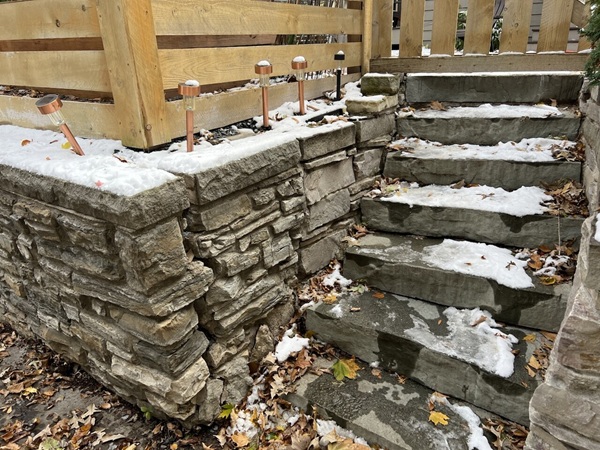
Wall Restored, Driveway Protected
The finished wall kept its original stone appearance while gaining structural reinforcement at the points that mattered most. The driveway and fence above it were never disturbed during the repair, which kept the project focused and limited in scope.
With the drainage tube in place, the wall is far less likely to face the hydrostatic pressure and soil saturation that caused the original failure. Salvaging the existing materials also meant the homeowner got a durable repair without the cost or disruption of a full rebuild.
Get Retaining Wall Help In Minneapolis
We work on mortared and dry-stacked retaining walls throughout Minneapolis, Edina, Minnetonka, and Wayzata, from full rebuilds to targeted corner and drainage repairs. Our crews evaluate what can be salvaged before recommending a full replacement.
Is a retaining wall on your South Minneapolis property showing signs of movement or cracking? Reach out and we can take a look.
Frequently Asked Questions
How do you know if a mortared wall needs repair in Minneapolis?
Signs include loosening or cracking mortar joints, visible movement at the corners, and bulging or leaning sections of stone. In South Minneapolis, freeze-thaw cycles and water pressure behind the wall are common causes of this kind of deterioration.
Can existing wall stone be saved during a repair?
Often, yes. On this South Minneapolis project, crews cleaned and reset the existing mortared stone rather than replacing it, reinforcing only the corners with steel connectors and concrete casing where the structure needed it most.
What maintenance does a repaired retaining wall need?
A repaired wall with proper drainage generally requires little ongoing maintenance beyond periodic inspection for new cracking or movement. Keeping the drainage tube clear of debris helps prevent the hydrostatic pressure that caused the original failure from building back up.